The Ways and Means of Caste Annihilation in Contemporary India: the Model of Ambedkar Representation
- Oct 28, 2016
- 14 min read
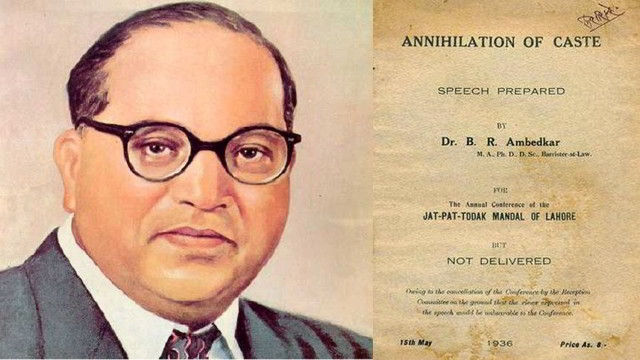
India is a country popularly known for all types of cultural and traditional systems. Beyond its excellence, it also faced so many problems; one among them is the caste system which is strictly followed in many regions since ancient period. For more than three thousand years caste system has retained its existence. Dr. B.R. Ambedkar was a renowned revolutionary leader who had to experience the rigidity of caste ridden society which motivated him to work for the welfare of the people mainly the Dalits. Moreover he was not only a social revolutionary but also the architect of Indian Constitution, educationist, brilliant lawyer, distinguished economist, anthropologist, sociologist, reputed author, orator, politician, trade union leader and preacher.
So many leaders and social reformers have fought against the caste discrimination but none of them could contribute more than that of Ambedkar through establishing a caste-less society. Using his rationality he was able to bring the backward communities after struggling, about forty years and sought a religion that could provide respect and dignity to the backward communities as the caste system was over ruled by the orthodox Hindus who didn’t permit Hinduism to change. He told –“Caste is the monster that crosses your path, you cannot have political reform, and you cannot have economic reform, unless you kill this monster”.
Ambedkar’s leadership provided a true and safe path for the overall development of the backward communities. He created a stir in the society for the first time by his well known works like “Who were the Shudras”, “The Untouchables”, “Why go for conversion?” etc... Daringly he defended those who became barricades in fulfilling his dreams, be it any prominent leader in the society. He totally sacrificed his life for this purpose in bringing the marginal people to the mainstream by different ways like, first and foremost studying about the castes and its origins, and then he dealt with legal framework of the nation. He was able to rethink and reform the society by his valuable contributions by which he is still alive today and forever in the hearts of the Indians.
Beginning of the Missions and its Mobility across Boundaries
Dr. Bhim Rao Ambedkar was born in an untouchable Hindu family (Mahar), on April 14, 1891. He has spent his childhood days and grown up in a caste ridden society in which he was treated as an inferior. The Untouchables were completely expelled from the villages, not allowed to enter the temples or any other sacred places; they were banned from performing rituals which the caste Hindus performed. Due to many reasons like this, they were compelled to take shelter near garbage dumps and slums which also weakened their health conditions. Out of the fourteen children of Ambedkar’s parents, Ramji and Bhimabai, only five of them survived. Young Ambedkar acquired his early education at the Government High School, Satara. Although as a student who showed excellence in his studies Bhim Rao was trapped by being an untouchable by birth. He had to face various humiliations and oppressions from his classmates and teachers. Ambedkar and his brother, Anandrao were made to sit on gunny bags in the corner of the class. Some teachers were fearful of getting polluted to ask questions or touch their notebooks or pens. At times, he had to go school without water due to the reason that he couldn’t collect water from the common source from where the caste Hindus fetched water.
This was the socio-economic background of Dr. Bhimrao Ramji Ambedkar. He was able to understand these experiences in such a manner that he dedicated his whole life for gaining dignity to the backward communities and bring them to the mainstream through legislation and different measures. These realities stirred Ambedkar’s mind in discovering the causes of these types of evil practices in the society.
Bhim Rao went to the deep researches in finding solution for these types of oppressions in the society. He excavated each and every point regarding this to edit for the formation of a class-less society. In Hindu society caste is the most important factor in identifying a person and his dignity. Initially it was ‘Chaturvarna’ (system of four castes) – Brahmins, Kshatriyas, Vaishyas and Shudras, but later these got subdivided into about 3000 sub castes along with Untouchables at the bottom of all these. If a person is born in one caste then his status, dignity and occupation is determined. He is restricted to think out of his caste.
In short, at the topmost level of all the castes are the Brahmins, the class which is dominating all the others. They are entitled to whatever good that exists. After Brahmins, are the Kshatriyas whose duty is to protect the people through battle against the enemies? Thirdly, are the Vaishyas – the trading class who are eligible to trade and feed the other two upper classes? At last, it is the Shudras who are not at liberty to learn anything. It is the Untouchables at the bottom of all castes and is unconstrained to suffer all the difficulties that come to them from high caste Hindus. It is told that the word Shudras existed in the Vedic period. However, Dr. B.R. Ambedkar uses a common word for both Shudras and Untouchables at most of the times. He describes their conditions as: The Untouchables form the lowest stratum of Hindu society. They were considered as a source of pollution. Practice of it is peculiar to the Hindu system. For them, the word Antya (which means the end of the village) is frequently used. Thus, it was a name given to those who lived in the outskirts of the villages. The Untouchables were called outcaste, unapproachable etc. They hardly had any respectable place in society. Even then, they themselves felt that they are not human beings. They were denied the use of the public wealth and their children were not admitted to schools attended by the caste Hindu children. All temples were close to them. They could not get service even from Barbers and washer men. They were treated as sub human. They could not think of public service including police and military. Day by day, their condition became miserable.
Realizing these Ambedkar decided to dedicate his valuable life for the upliftment of the backward society He happened to understand the caste and the backward communities. According to Ambedkar, he feels sorry for those who try to defend the caste system telling that it is a mere division of labour. Very theoretically he attacks that, if it is just division of labour then that is useful in providing employment for the public in relation to their qualification but it is not just like that. He tells – It is a hierarchy in which the divisions of labourers are graded one above the other. In no other country is the division of labour accompanied by this gradation of labourers.
Ambedkar’s understanding about the origin of Shudras tells that it was from an allegorical story of many long wars that took place between Vasistha and Viswamitra in which one of them was a Brahmin priest and the other was a Kshatriya priest. They fought for supremacy and were in hostility relating to the matters of priesthood. For a long period of time, the higher position was occupied by the strong supporter of Visvamitra – Raja Sudras but the victory was hoisted by Vasistha and his Brahmins. They celebrated this victory by condemning the progeny of Shudras to inhumane activities, making them settle on the lowest part of the social ladder. In this manner, they lived as a degraded class in the Indo-Aryan civilization. As a result of antagonism towards the Shudras, the Brahmins were not ready to perform the Upanayana (ceremonies) of the Shudras. Before this, the Aryan society consisted of only three Varnas; the Shudras were part of Kshatriya Varna. By this, they fell below the rank of Vaishyas and thus resulted to the fourth Varna.
As stated, about the difference between the Shudras and Untouchables, Ambedkar also was talented in stating the origin of Untouchables. As appears from his understandings, in primitive societies there were tribal communities based on blood relationship who were nomads. The earliest form of wealth they had was the cattle which had a character of migration. When the new kind of wealth, land was found these nomadic communities became settled communities. The improvement in agriculture became the major source of income; thereby the society got settled completely. As the time passed, troubles began continuously among them. The defeated tribes were left with nothing. They were tribesmen roaming in all directions prone to have no shelter and protection. So, the settled communities bargained them as they agreed to work and receive food and shelter. As they were strangers, they lived outside the villages. This also makes clear that the Untouchables from the very beginning lived outside the village.
There are many terms used to denote the Dalits who include Dasa, Dasya, Rakshasa, Asura, Avarna, Nisada, Panchma, Chandala, Harijan and Untouchables. There are also other names, according to the regional languages. All these names include a common theme that “we – the pure & you – the impure”. In response to this, with the charismatic leadership of Dr. Ambedkar the term Dalit gained much popularity and significance which was adopted by the Dalits themselves to indicate that they are most exploited and humiliated section. This is not a mere term denoting that they are subjugated whereas it is an expression of hope for the Dalits. Mahatma Gandhi called them “Harijans” but the Dalits were not ready to accept this because this didn’t reflect on their conditions.
According to Stanley Rice, the origin of Untouchables is different. He explains that the Dravidians conquered the non-Dravidians and made them Untouchables. Later, Aryans conquered the Dravidians when they invaded India. However, Ambedkar believes that the theory of Stanley has a link missing between the chains of events. It gives possibility for a number of questions that had to be answered. Mr. Rice also gives an Occupational Theory of Untouchability telling that the untouchability originated due to the filthy and unclean occupations of them. Ambedkar does not agree with such theories as he questions: However, there are certain difficulties in the way of its being accepted as a true explanation of the origin of untouchability. The filthy and unclean occupations, which the Untouchables perform, are common to all human societies. In every human society, there are people who perform these occupations. Why were such people not treated as Untouchables in other parts of the world?
A deliberation obviously arises that what is the ethical significance of these theories and origins that Ambedkar has discovered which really is the work of any historian or sociologist? It can be truly observed that the basic step is to study the causes and by this it is clear that whatever might have been the motive to be superior to the other classes, there was a lack of humanitarian behavior, democracy and social harmony between the different castes in Indian society.
On the Genealogy of Ambedkar Counter-Discourses
Numerous social reformers and religious leaders have tried to improve the conditions of Dalits. Though great personalities like Ramakrishna, Vivekananda, Ramana Maharishi, Aurobindo and Gandhi had their tremendous effort to uplift these societies but their thoughts didn’t work beyond the caste system. They all tried to uphold the caste system which was considered as an essential part for the sound functioning of the Indian society. Beyond every obsession it was Dr. Ambedkar who understood the problems of the Dalits in a different perspective. He believed that any effort without annihilating the castes is in vain. He tells that a country of castes is a country of stagnation and underdevelopment but was it easy to annihilate the caste system? It had got engraved deeply in the Hindu scriptures and had its significance and sacredness greatly on the people. Hindu scriptures mainly consist of the Vedas, Upanishads, Smritis and Puranas including the Ramayana and the Mahabharata. The caste system among the Hindus has all its literary evidence aptly. For instance, in the famous Chandogya Upanishad a comparison between the three upper castes and Chandala (outcaste) can be read as follows: Accordingly, those who are of pleasant conduct hear the prospect is, indeed, that they will enter a pleasant womb, either the womb of a Brahmin, or the womb of Kshatriya or the womb of a Vaishya. But those who are of stinking conduct here, the prospect is, indeed, that they will enter a stinking womb either the womb of a dog or the womb of a swine or the womb of an outcaste [Chandala].
In view of Ramayana, only the three upper castes were allowed to perform Tapas. Once it happened that a Shudra performed Tapas in order to attain divinity. When lord Rama heard this he killed him. The Brahmins who were entitled to all types of learning and luxuries tried to suppress the downtrodden castes in order to maintain their superiority. That is why Ambedkar shared that social reformation is necessary prior to economic reformation. The priest society was always domineering religious and non-religious matters. The social dignity of an individual itself becomes a reason for power and authority. In fact, why do millionaires respect penniless Sadhus and Fakirs? Why do the poorest among the poor sell their least valuable ornaments to pilgrimage Benares or Mecca? As religion is the main source of power, it is controlled by the priest over the people inferior to them. Gopal Guru Quotes that Ambedkar’s view of Hindu religion is “Hindu law is that law of the established order and was made by the touchable. The untouchables had nothing to do except to obey it and respect it. The untouchables have not rights against the touchable. For them there is no equal right, not justice which is due to them and nothing is allowed to them. Nothing is due to them except what the touchable are prepared to grant. The untouchables must not insist on rights. They should pray from mercy and favour and rest content with what is offered”.
So, before taking in account the economic reformation Ambedkar engaged in his social reformation. He realized that caste is a powerful weapon that is preventing from all reforms and the key to the reformation is destroying the castes but as it is a religion deeply indulged in caste system it was tough to overcome a change. He was of the view that destroying caste system would not alter the Hindu religion negatively but the reality was vice-versa. Ambedkar defined religion in a very unique manner. Religion can be defined as belief in God. Ambedkar puts a brainstorm to question - “what advantage can there be in believing God?” as he himself answers: Belief in God gave rise to the belief in the efficacy of worship and prayer, and the efficacy of worship and prayer gave rise to the office of the priest and the priest was the evil genius who created all superstitions and thereby destroyed the growth of right view. He didn’t explain anything about God in his understanding and he has taken it in social a perspective. For him, “a true religion was the upliftment of the individual. It should teach the virtues of fellow-feeling, equality and liberty”
By this it is crystal clear that Ambedkar’s views were pertaining to attain his mission successfully. The definition of Bhim Rao was an antithesis to the Hindu religion and hence it must be abandoned from the society. Unfortunately, there were so many to protect the Hindu society from its abolition of caste system. The priesthood maintained by the upper castes strongly upheld the caste society. Ambedkar was of the opinion that until the casteism is banned a nation couldn’t be built, morality cannot be imagined. He kept on repeating his opinions in his speeches to the Hindu audiences. He advised that if Hindu society is to progress, its tradition must be able to evolve.
Ambedkar also made the caste Hindus think by putting forward some rhetorical questions so that they realize. Despite listening to all types of valuable speeches of Ambedkar, the Hindus didn’t look forward for a change. The orthodox Hindus still remained firm in their class society. They didn’t welcome the rational thoughts of Dr.B.R.Ambedkar in building up a democratic nation that is free from all types of inequalities and social disparities. This challenging personality didn’t give up his struggle whereas he decided to move away from the religion which is encouraging disharmony. He addresses lastly to the Hindu audiences as follows: I’m sorry; I will not be with you. I have decided to change. This is not the place for giving reasons. But even when I am gone out of your fold, I will watch your movement with active sympathy, and you will have my assistance for what it may be worth. Like this, Ambedkar decided to leave Hinduism which is not willing to evolve to its most beautiful form.
On 29 August 1947, Ambedkar was appointed as the chairman of the Drafting Committee for Indian Constitution. He tried to provide protection and constitutional guarantees for the citizens of India especially for the marginalized classes abolishing all types of discriminations. He was also talented to win the Assembly’s support for implementing a system of reservation for jobs and education. As Ambedkar had a good prominence between the untouchables, he was invited by the British for the Second Round Table Conference in London in 1932 demanding a separate electorate for the Untouchables. On 16 August 1932 British Prime Minister Ramsay Macdonald agreed with Ambedkar and announced a Communal Award that will grant a separate electorate for them. This was strongly disagreed by Gandhi who protested by fast when he was imprisoned in Yerwada Central Jail of Poona. Altogether orthodox Hindus and its leaders got annoyed which feared Ambedkar that this will lead to a communal reprisal and genocide acts against the untouchables, Ambedkar had no way except agreeing with Gandhi. However, his agreement that broke Gandhi’s fast and Ambedkar to drop his demand was called the Poona Pact. Still facing all these challenges he was very much lucky to contribute for drafting the Indian Constitution. Freeing from the colonial rule, Ambedkar was welcomed to serve as the India’s first law minister by the new government. Granville Austin describes the drafted Indian constitution of Ambedkar as –”first and foremost a social document’. … ‘The majority of India’s constitutional provisions are either directly arrived at furthering the aim of social revolution or attempt to foster this revolution by establishing conditions necessary for its achievements”.
The main three concepts of Ambedkar which he tried to include in the preamble of the constitution are Liberty, Fraternity and Equality. These are the concepts of justice that originated from the French Revolution of 1789, which inspired him greatly. Ambedkar has divided liberty into two main categories; Civil Liberty and Political Liberty. The former is the obligation of government to protect Dalits from discriminations and violations. These liberties are formally guaranteed in the Indian Constitution but ignored in practice. The latter consists of rights of an individual for taking part in the law making process and sharing his/her views. Secondly, Ambedkar himself defines fraternity as it can be read - “Fraternity means a sense of common brotherhood of all Indian, all Indians being one people. It is the principle which gives unity and solidarity to social life”. When getting into equality, Ambedkar grasps that a man’s power is dependent on many of his features like education, effort, parental care, etc... Based on these efforts and skills a person should be really be valued and not under any hereditary class. He also focuses on political equality that the backward mass should get educated and beware of their rights so that no one usurps their individual values. He also suggested that economic equality emphasizes the quality of opportunity, adding that work consideration by the state through the law of constitution is necessary. A lot of contributions by Ambedkar were successfully enacted as he firmly believed that law is a powerful weapon to fight against discrimination.
Post Script
Understanding all the conditions of Indian society, B.R.Ambedkar laid down certain social, economical and political laws through the legal framework of Indian Constitution in order to provide security for all the discriminated communities, be it on the basis of caste, gender, creed, race, literacy, ability, etc..That should be abided by the citizens of this nation. These played a crucial role in abolishing the caste system from our country but majority of the rural areas in our country which are still underdeveloped face these sorts of problems even today. As the heart of a nation rests in the villages, despite the laws for letting a man live free, there are discriminations still alive in rural areas. How can these areas be freed from these types of dreadful activities? What are the solutions for these problems? It is the juxtaposition of the rethought on the possibilities in Ambedkar’s views about the annihilation of caste system in India.
There are still orthodox communities who have not wished to change their minds must be seen through that the rules of the Indian Constitution is mandatory to be followed by which India can dream for a nation free from all types of oppressions. The three basic principles of Ambedkar- Liberty, Fraternity and Equality that is the fundamental platform, should be taken for a critical introspection by the constitutional affairs of India. Above all, if the teachings of Ambedkar are executed in proper manner, definitely India can fulfill the mission of this altruistic personality and lastly, hands must be joined together to make his following words come true:
“…in the free India of the future, we will be a ruling race. We refuse to continue to play a role of subservience or accept position in which we should be treated as servants, not masters. The days of domination of one community over another were certainly over and I want to make it known that the Scheduled Castes are determined to fight for their rights and claim their due share in the administration of the country”.
Comments